
Frio County Parole vs Probation
The key question is what legal event put the person under supervision. Parole and mandatory supervision follow confinement in TDCJ. Probation, called community supervision in Texas records, comes from a court order and can occur instead of a prison term. Neither status means the person remains in the Frio County Jail, and neither is proved by a county jail roster.
| Issue | Parole or mandatory supervision | Probation |
|---|---|---|
| Source | Release from TDCJ under state law and a Board or statutory process | Frio County court judgment or community-supervision order |
| Agency | TDCJ Parole Division and the Texas Board of Pardons and Paroles | Frio County Adult Probation and the sentencing court |
| Best proof | Release record, supervision record, or Parole Division confirmation | Signed court order, docket entries, and authorized office confirmation |
| Ending record | Discharge or other final Parole Division record | Court order showing completion, early termination, revocation, or other disposition |
Verify Frio County Post-Release Supervision
Start with the last confirmed authority, not a broad name search. Frio County includes a county jail, the Dolph Briscoe Unit, and two immigration facilities, so an agency mismatch can produce a false conclusion. Use the following sequence for an adult record.
- Read the judgment, release paperwork, or last custody record and decide whether the person left TDCJ or received community supervision from a Frio County court.
- For TDCJ, use TDCJ IVSS and the official offender-information channels. Search with a TDCJ number, SID, or exact date of birth when available.
- If a parole case is still under review, call the Board status line at 844-512-0461. After a favorable vote, call the Parole Division release-status line at 512-406-5202.
- For probation, obtain the sentencing or community-supervision order and later docket entries from the correct Frio County clerk, then ask Adult Probation what it may confirm.
- Request the final discharge, completion, revocation, or termination record. A current lookup result is useful, but the originating record is the durable proof.
A favorable parole vote is not the gate event; use the post-vote line or actual release record to confirm that release occurred.
Frio County Adult Probation Office
Frio County publishes a concrete local contact for court-ordered adult community supervision. This office is separate from TDCJ parole. Court papers should be checked before directing an inquiry there, because a person released from a state prison may instead be assigned to a Parole Division office.
Call before travel. Another official CIRA page has displayed details that differ from the main county page, so the main page and telephone confirmation are the sound publication-day check. No public person-by-person Frio County probation lookup was verified.
Frio County Violations and Absconders
Conditions depend on the controlling order and can include reporting, approved residence, travel limits, programs, or other case-specific terms. A suspected violation is not itself a final finding. Parole revocation has its own notice and hearing process, while probation action returns to the sentencing court.
TDCJ defines an absconder as a supervised person who stopped reporting and whose location is unknown. Its anonymous tip line is 866-680-6667. A parole warrant points to an unresolved supervision issue, but does not prove that the person is now held in Frio County or any named facility. TDCJ's public web search covers only absconding sex offenders and must not be treated as a full parole-absconder database.
Identity in the limited absconder search cannot be confirmed from a similar name alone; TDCJ warns that fingerprint linkage is conclusive.
How Frio County Supervision Ends
Supervision does not end merely because a name stops appearing in a current search. TDCJ parole or mandatory supervision may end through discharge, revocation, or another recorded action. Frio County probation may end through completion, early termination, revocation, or a later court order. Ask for the document that states the event and effective date.
For a former TDCJ client, requests can seek the actual release or discharge date, release type, public supervision status, and the source sentence. TDCJ routes supervision and location questions to io@tdcj.texas.gov and Parole Division public-information requests to pia@tdcj.texas.gov. Include the full name and a TDCJ number, SID, or date of birth. The broader Frio County released-inmate search guide explains how to pair that record with the original custody and court trail.
Frio County Parole Review Is Case Based
Texas does not publish the sort of person-by-person public parole hearing calendar many readers expect. Initial consideration is generally a file review. About six months before initial eligibility, or four months before a later review, the Parole Division identifies the case and begins processing. An institutional parole officer prepares a summary, notices are sent, and a three-member panel votes in sequence. Two votes decide the case.
An offender interview is discretionary, while a requested victim interview is required. The person receives a written decision, and a denial includes the next review date. Public Board governance meetings are not individual inmate hearings. Use the official Board review explanation for the process, then use the status line for a specific case.
Frio County's Two Supervision Paths
The Pearsall Adult Probation office is the distinctive local layer. Its presence does not make it the right office for every released person. A Frio County court order points to local adult probation. A TDCJ release certificate or parole record points to the Parole Division, even if the underlying conviction arose in Frio County.
This distinction also shapes records access. The local court retains the judgment and community-supervision orders, while TDCJ and BPP hold parole review, release, and supervision records. Requesting from the wrong office can yield a truthful “no record” that says nothing about the other system.
Frio County Supervision Alerts
TDCJ IVSS can provide notices tied to prison custody, parole eligibility, Board decisions, release, discharge, and supervision events. It is distinct from IVSS-Counties, which covers county jail and court events when local data are available. A Frio County Jail bond release belongs in the county layer; a Dolph Briscoe Unit parole event belongs in the state layer.
Alerts are leads, not certified records. Save the notice, read the event wording, and confirm it with the agency that created the event. A transfer, bench-warrant movement, or supervision change should not be relabeled as an unconditional community release.
The official TDCJ IVSS page shows the state custody and parole notification route.
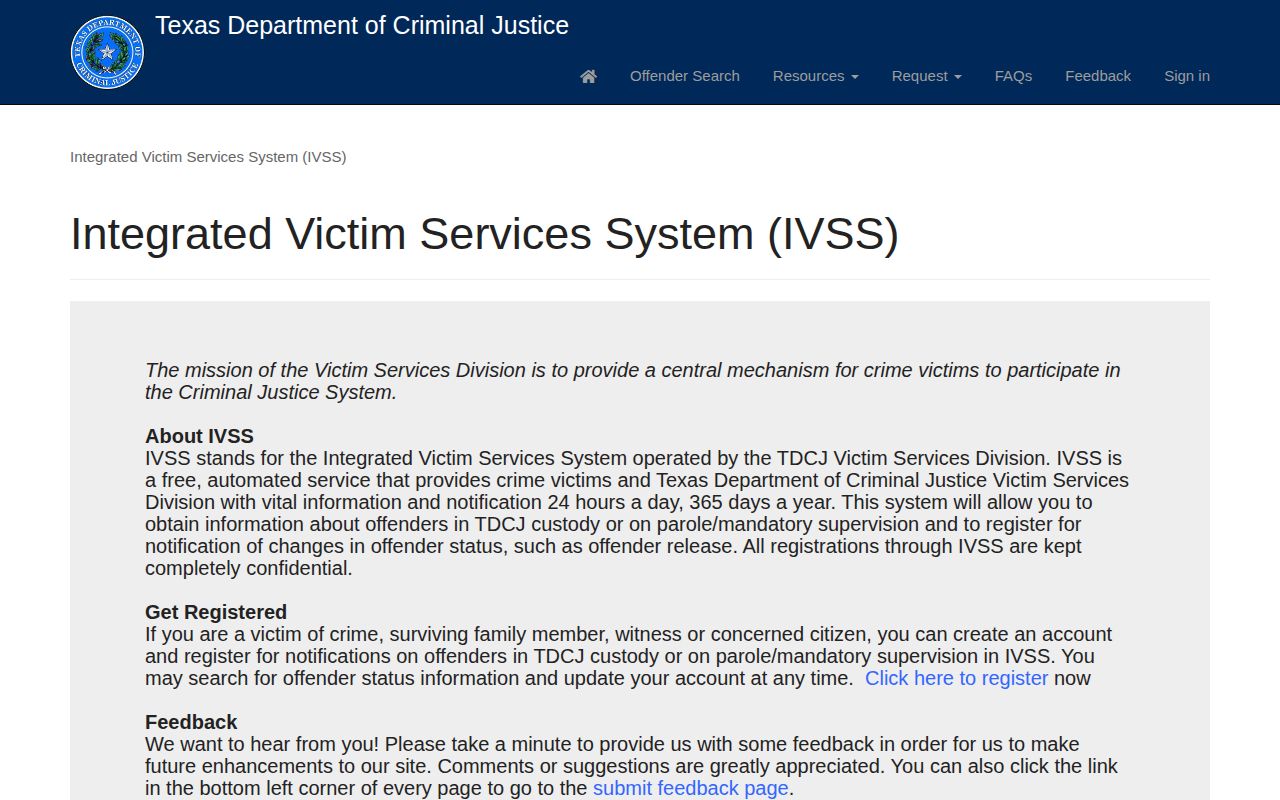
The captured interface helps distinguish state notifications from the Frio County jail notification layer.
Frio County Parole Decisions and Release
Board decision codes describe an administrative outcome, not always an immediate exit. FI-1 means release when eligible. FI-2 sets release on a future date. Several other FI codes require a program, transfer, or other condition. RMS concerns release to mandatory supervision. Denial codes can set another review or require the balance to be served, and the Board may withdraw an approval if new facts arise.
For that reason, verify the sequence. First identify the decision and date. Next ask whether all stated conditions were met. Then use the post-vote release-status channel and obtain the actual release record. If supervision follows, request the supervising status and public office information. This prevents a favorable vote from being reported as a completed Frio County release.
Revocation is a later process concerning alleged conduct after release. BPP says a revocation decision generally takes two to four weeks and is delivered through the parole officer. The result can affect custody and supervision, but an allegation or warrant is not the final decision.
Records for Frio County Supervision
Texas Public Information Act requests should name the record rather than ask an agency to answer a broad legal question. For parole, useful targets include the release certificate, actual release or discharge date, public supervision status, and a final revocation or discharge record. For probation, ask the proper clerk for the judgment, community-supervision order, later modification, and completion or revocation order.
Some information may be confidential or withheld under an applicable exception. Let the office identify the legal basis in writing. A portal result can change, while the signed court order or agency event record preserves the official action and effective date.